Ireland's Cliffside Cottages: Moody, Wild and Breathtakingly Beautiful
Discover Ireland's most dramatic cliffside cottages — perched above crashing Atlantic waves, wrapped in wildflowers, and surrounded by raw, untamed landscapes. Your complete guide to Ireland's wild coastal escapes.
Ireland's Cliffside Cottages: Moody, Wild and Breathtakingly Beautiful
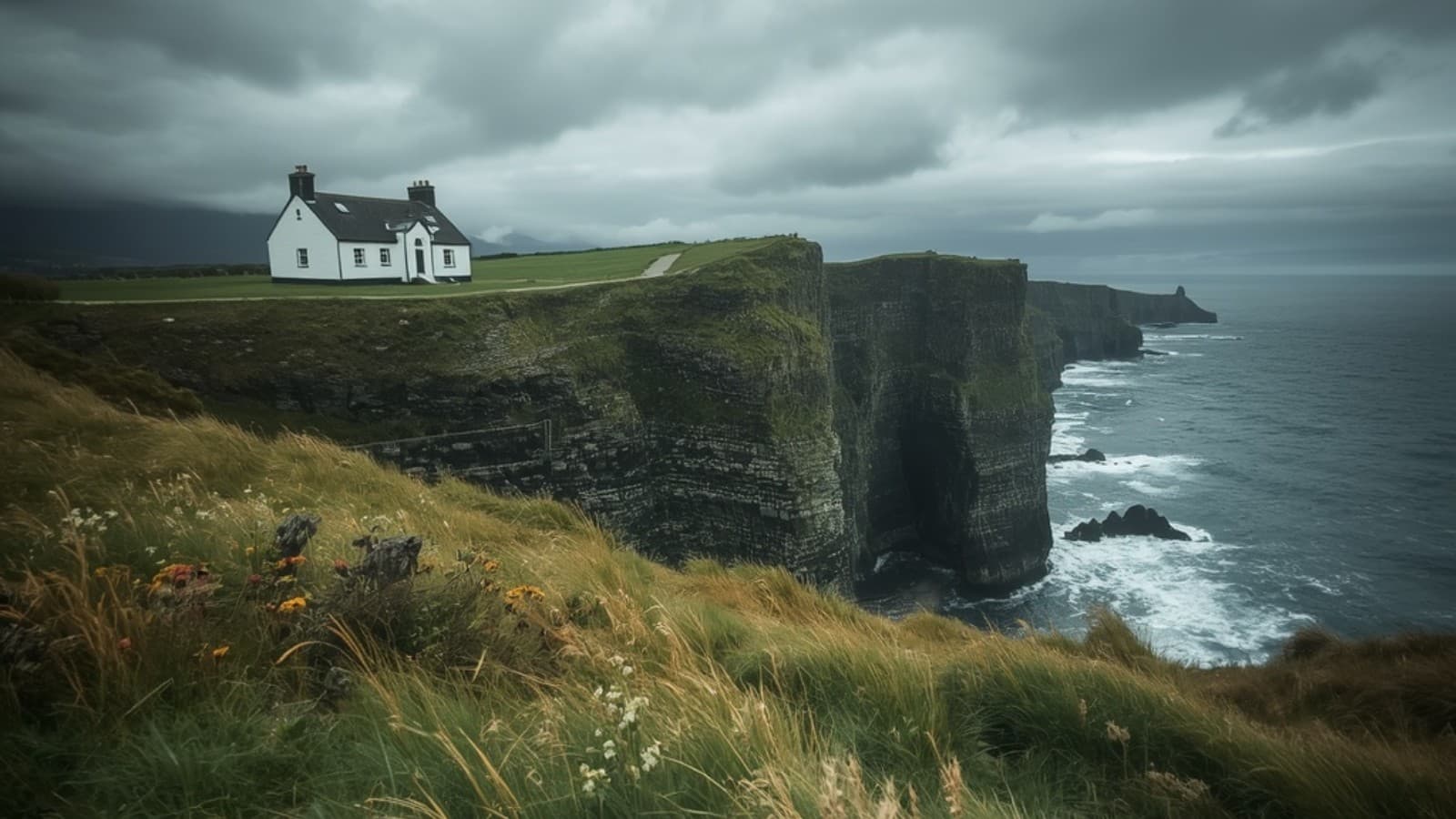
There is a particular kind of beauty that belongs to the western edge of Ireland — one that does not try to charm you gently or seduce you with warmth. It confronts you. The wind comes off the Atlantic without warning, the light shifts from silver to gold to charcoal in the space of an afternoon, and the cliffs drop away beneath your feet with a directness that makes the stomach tighten. And then, perched impossibly at the edge of all of it, a whitewashed stone cottage sits as if it has always been there — because it has.
Ireland's cliffside cottages are not a travel aesthetic. They are real structures, built by real people generations ago, positioned on the most exposed and dramatic coastline in Europe because that was where the land was, and the sea was the road. That they happen to look extraordinary — framed by wildflowers in summer, shrouded in Atlantic mist in autumn, silhouetted against storm skies in winter — is simply the consequence of existing in one of the most visually dramatic landscapes on the planet.
This guide covers where to find them, how to experience them, what makes them architecturally and culturally significant, and how to photograph and travel through the wild western coast of Ireland with the depth it deserves.
What Makes Ireland's Coastal Landscape So Dramatically Different
Ireland's western coastline stretches for over 2,500 kilometres from the Inishowen Peninsula in Donegal in the north to the Mizen Head in Cork in the south. The Wild Atlantic Way, the coastal driving route that traces this entire length, is the longest defined coastal route in the world. But the statistics do not capture what makes this coast feel so unlike anywhere else in Europe.
The difference is geological and meteorological. The western coast of Ireland sits at the point where the European continent ends and the open Atlantic begins. There is no landmass between the cliffs of County Clare and the eastern seaboard of North America — nothing to slow the weather systems, break the swell, or diminish the scale of what arrives from the ocean. The result is a coastline defined by extremity: extreme weather, extreme geology, extreme light, and an extreme sense of being at the edge of the known world.
The Geology That Creates the Drama
The cliffs of the western Irish coast are predominantly composed of Carboniferous limestone and Old Red Sandstone laid down three hundred million years ago and subsequently shaped by glaciation, wave action, and the relentless erosion of Atlantic storms. The Cliffs of Moher in County Clare rise to 214 metres at their highest point. The sea stacks and arches of County Clare, Galway, and Mayo create profiles that look architecturally deliberate — columns, bridges, and towers of rock standing offshore in the breaking surf.
The Aran Islands, sitting at the mouth of Galway Bay, are composed entirely of the same Burren limestone that defines the nearby Clare coastline — a grey, fissured karst landscape that produces almost no soil but supports an extraordinary range of wildflowers that bloom in the cracks between the rock. The visual contrast between this pale grey stone and the vivid green of Ireland's grass-covered hillsides is one of the defining colour relationships of the western landscape.
The Light and Weather That Define the Mood
Ireland's Atlantic coast receives weather from three directions simultaneously and changes conditions multiple times in a single day with a speed that consistently surprises visitors accustomed to more stable climates. A morning of dense grey cloud and horizontal rain can give way to a golden afternoon of extraordinary clarity, the washed air making distant headlands appear close enough to touch. This volatility is not a drawback — it is the engine of the landscape's visual drama.
The light quality on the west coast of Ireland is unlike that of any Mediterranean or continental European destination. It is a diffused, silver-grey light that flattens harshness and renders every surface — wet stone, pale grass, white cottage walls — with an almost photographic clarity. When direct sunlight does break through, usually in the late afternoon or at golden hour, the contrast with the dark ocean and the grey-green landscape is genuinely extraordinary.
The Cliffside Cottage: Architecture, History and Meaning
The stone cottages that appear throughout the western Irish coastline are not picturesque by accident or design. They are the product of centuries of pragmatic building in response to a specific environment, and their beauty is inseparable from their function and their history.
The Traditional Irish Cottage: How It Was Built
The vernacular architecture of the west of Ireland developed over several hundred years in response to the demands of the Atlantic climate. The typical traditional cottage is a single-storey rectangular structure built from locally quarried stone — most commonly the grey limestone of the Burren or the darker granite of Connemara — laid without mortar in the driest stone walling technique or pointed with lime mortar that allowed the walls to flex and breathe in the damp climate.
Walls are typically between 60 and 90 centimetres thick, providing the thermal mass needed to retain heat through the cold, wet Atlantic winters. Windows are small and deep-set, positioned to minimise wind exposure while admitting enough light to the interior. The roof was traditionally thatched with local marram grass or rushes, tied down with a network of ropes and weighted stones to resist the wind — a detail that gives the oldest surviving examples a distinctive silhouette that no other building tradition in Europe quite replicates.
The whitewashing of cottage walls — applied annually to protect the lime mortar from water penetration — creates the brilliant white facades that make these buildings visible from enormous distances across the dark landscape. A whitewashed cottage on a green headland above a grey sea is visible from several kilometres away, and this visibility was practical as well as beautiful: it made the cottage identifiable from the sea, a navigation point as well as a home.
The Human History Behind the Landscape
The concentration of cottages on the western coast of Ireland is inseparable from the history of the island. The west was the most densely populated rural region in pre-Famine Ireland, supporting extraordinarily large numbers of people on small plots of poor coastal land through subsistence farming and fishing. The Great Famine of 1845 to 1852 devastated these communities with a severity felt nowhere in Europe outside of wartime. The population of Connacht — the western province encompassing Galway, Mayo, Roscommon, Leitrim, and Sligo — fell by over thirty percent in a decade through death and emigration.
Many of the roofless stone ruins visible throughout the west of Ireland today are the remains of pre-Famine cottages, abandoned during or after those years and never reoccupied. They sit in fields, on hillsides, and at cliff edges, their gables standing and their interiors open to the sky, weathered now to the same grey-green tone as the surrounding rock. They are not scenic props. They are the physical record of one of the worst humanitarian disasters in nineteenth-century European history, and understanding that changes how you see the landscape.
The cottages that survived and were maintained through subsequent generations are a direct continuity with that history. Staying in one, or simply standing outside one on a cliff path above the Atlantic, places you in a line of occupation that runs back centuries.
The Best Locations to Find Cliffside Cottages in Ireland
The western coast of Ireland spans six counties and thousands of kilometres of coastline, but certain areas concentrate the visual drama and the traditional cottage architecture in ways that make them particularly rewarding to visit.
County Clare and the Burren Coast
County Clare is arguably the most dramatically scenic county on the Wild Atlantic Way and the most concentrated combination of limestone geology, cliff scenery, and traditional settlement. The Burren — the vast limestone plateau that covers the northern third of Clare — meets the Atlantic at Loop Head in the south and at the Cliffs of Moher and Black Head in the north, creating a coastline that shifts between sheer vertical drops and low rocky shores depending on where you stand.
The villages of Doolin, Liscannor, and Kilronan on the Aran Islands retain the highest concentration of traditional stone cottages in active use on the Clare coast. The road from Doolin north along the coast to Black Head is one of the most atmospheric drives in Ireland, with stone walls, cottage ruins, and the dark grey Burren landscape falling away to the Atlantic on the left and rising toward the plateau on the right.
Loop Head, at the southwestern tip of Clare, is less visited than the Cliffs of Moher and more rewarding for precisely that reason. The headland narrows to a dramatic point above 60-metre sea cliffs, and the single road leading out to the lighthouse passes a series of traditional farmhouses and stone-walled fields that feel genuinely unchanged from a century ago.
Connemara and County Galway
Connemara occupies the western half of County Galway and presents a landscape that is rawer and less ordered than the limestone geometry of the Burren. Here the geology is older — Connemara marble and Galway granite — and the coast is composed of hundreds of small inlets, islands, and headlands rather than the long straight cliff lines of Clare.
The coastal road from Clifden south through Roundstone to Cashel is one of the most beautiful drives in Ireland. Traditional cottages appear throughout the landscape, many painted in the white or pale pastel colours that distinguish Connemara building from the greys and ochres of other western counties. The Twelve Bens mountain range rises behind the coast to the north, creating a backdrop of dramatic scale behind every coastal composition.
The Inishbofin and Inis Meain islands off the Galway coast retain cottage architecture and a pace of life that the mainland has largely moved beyond. Day trips are possible from Cleggan and Rossaveel respectively, but staying overnight on either island provides a depth of experience that no day visit can match.
County Mayo and Achill Island
Achill Island, connected to the Mayo mainland by a short bridge, is the largest island off the Irish coast and one of the most visually spectacular. The sea cliffs at Croaghaun on the island's western end are among the highest in Europe at nearly 700 metres, dwarfing even the Cliffs of Moher in scale if not in accessibility.
The abandoned village of Slievemore on Achill is one of the most moving sites on the entire Wild Atlantic Way — a complete pre-Famine settlement of over one hundred stone cottage ruins arranged in a single long street on the north slope of Slievemore mountain, facing directly out to sea. The cottages are roofless now, their interiors filled with grass and foxgloves in summer, and the village has the quality of a held breath — everything in place, everyone gone.
The village of Keel on Achill's southern coast has a number of traditional cottages in active use overlooking a long white sand beach, and the road around the island's western tip offers cliff views and coastal drama comparable to anywhere in Ireland.
The Dingle Peninsula and County Kerry
The Dingle Peninsula in County Kerry projects into the Atlantic south of the mouth of the Shannon and concentrates an extraordinary range of landscapes — sea cliffs, sandy beaches, mountain passes, and some of the oldest human settlement sites in Ireland — within a relatively small area.
The Blasket Islands, visible from the tip of the Dingle Peninsula, were inhabited until 1953 when the last permanent residents were evacuated to the mainland. The islands supported a community of Irish-speaking fishermen and farmers for centuries, producing a remarkable body of autobiographical literature in the Irish language before the final evacuation. The ruins of the village on the Great Blasket are visible from the mainland and accessible by ferry in summer, and they represent perhaps the most complete picture of the traditional island cottage way of life in Ireland.
The Slea Head Drive on the Dingle Peninsula passes a continuous sequence of archaeological sites, traditional cottages, and cliff views that make it one of the most rewarding driving routes in Ireland.
Experiencing Ireland's Wild Coastal Landscape as a Traveler
The western coast of Ireland rewards a particular approach to travel — one that prioritises time over distance, depth over coverage, and patience with the weather over the insistence on sunshine.
Moving Slowly on the Wild Atlantic Way
The Wild Atlantic Way is designed as a driving route, but its 2,500-kilometre length is impossible to experience fully in any normal holiday duration. Rather than attempting to cover the entire coast in one trip, most experienced visitors choose a single region — Clare and the Burren, Connemara, Achill, or the Dingle Peninsula — and spend three to five days within that area, exploring on foot and by car with no pressure to move on.
This approach allows for the kind of weather patience that the west coast requires. A day of heavy rain and low cloud is not a wasted day — it is a different kind of day, often producing the most atmospheric and dramatically beautiful light conditions of the trip. The mistake most first-time visitors to the Irish west coast make is fighting the weather rather than accepting it as part of the experience.
Walking the cliff paths — the Burren Way, the Dingle Way, the Western Way in Connemara — provides access to sections of coastline and viewpoints that are invisible from the road. The cliff path from Doolin to the Cliffs of Moher, for example, passes a series of headlands and sea caves that the car park at the main visitor centre entirely misses. Allow a full day and walk it in the direction that puts the afternoon light behind you.
Staying in a Traditional Cottage
Self-catering rental in a traditional or restored stone cottage is the accommodation choice that most fully immerses you in the landscape. There are several hundred such properties available to rent on the western coast, ranging from modest one-bedroom cottages with basic facilities to fully restored historic farmhouses with modern interiors behind original stone exteriors.
The key qualities to look for in a cliffside or coastal cottage rental are the view from the main living space, the proximity to cliff paths and walking routes, and the quality of the heating system — Atlantic evenings are cool even in July and a cottage without reliable heat is a miserable experience regardless of how beautiful the view. Properties on elevated ground north of Doolin in Clare, on the Connemara coast between Clifden and Roundstone, and on the western tip of the Dingle Peninsula consistently deliver the combination of view, access, and character that defines the ideal Irish coastal cottage stay.
The Best Time of Year to Visit
Ireland's western coast is accessible and rewarding year round, but different seasons offer fundamentally different experiences.
Late May through June is the best combination of mild weather, long days, and manageable visitor numbers. The wildflowers that grow in the limestone cracks of the Burren and on the cliff margins are at their peak, the evenings extend past 10pm at this latitude, and the Atlantic has not yet fully warmed to summer swimming temperature but the air is pleasant for long days walking.
July and August bring the warmest temperatures and the highest visitor numbers. The famous sites — the Cliffs of Moher, Doolin, Dingle town — become genuinely busy, but ten minutes' walk from any car park puts you back in solitude. The coast in high summer has a completely different character from its moody grey-season self — brighter, more social, more accessible — and both versions are worth experiencing.
September and October are the months preferred by photographers and those seeking the most atmospheric conditions. The summer crowds have thinned, the light has returned to the oblique and dramatic quality of spring, and the first Atlantic storms of autumn begin arriving, producing the dramatic wave action and cloud formations that define the west coast's most iconic imagery.
Photographing Ireland's Cliffside Cottages and Coastal Landscape
The Irish west coast is one of the most technically demanding and most rewarding landscapes for photography in Europe. The light changes constantly, the weather moves quickly, and the scale of the landscape requires careful compositional thinking to convey in a two-dimensional frame.
The Quality of Light on the Atlantic Coast
The west of Ireland sits at approximately 53 degrees north latitude, which means that golden hour light in summer lasts significantly longer and arrives at a much lower angle than in Mediterranean locations. In late June, the sun sets at close to 10pm local time, and the golden hour begins around 8:30pm — meaning the most beautiful evening light arrives when the landscape is at its most alive and the air is at its warmest.
The low angle of golden hour light on this coast does something remarkable to the texture of old stone. The rough limestone of the Burren, the dry stone walls, and the whitewashed facade of a cliff cottage in late evening light acquire a depth and warmth that is impossible to replicate at any other time of day. Arrive at your chosen cottage location at least an hour before sunset and shoot continuously through the entire golden hour.
Overcast conditions, which are frequent and should not be avoided, produce a soft and even light that renders the green of Ireland's grass with extraordinary saturation. The phrase Forty Shades of Green is not merely poetic — the range of green tones visible in a Connemara hillside on an overcast July day is genuinely that varied, from the near-black of wet bog to the yellow-green of new fern growth to the deep blue-green of Atlantic grass on cliff margins.
Composition in a Complex Landscape
The challenge of composing a photograph on the Irish west coast is managing the visual complexity of a landscape that contains multiple strong elements simultaneously — sky, sea, cliff, stone wall, cottage, grass, and often breaking waves in the foreground.
The most effective approach is to choose one primary subject and build the composition around it. If the subject is the cottage, simplify the foreground and allow the sky or sea to provide the background context. If the subject is the cliff or the breaking wave, position the cottage as a secondary element that provides scale and human reference rather than competing for visual primacy.
Shoot into the weather rather than waiting for it to clear. Some of the most powerful images of the Irish coastal landscape are made in the minutes before or after a rain shower, when the light is dramatically directional, the air is freshly washed, and the contrast between dark cloud and pale stone is at its most extreme. Keep your camera accessible at all times on the Irish coast — the best light often arrives unexpectedly and lasts only minutes.
Why Ireland's Cliffside Cottages Remain Unforgettable
Every visitor to the west of Ireland eventually encounters the same feeling: that the landscape is larger, older, and more indifferent to human presence than anything they expected. The cliffs do not pose for photographs. The weather does not cooperate on schedule. The ruins do not explain themselves. And somehow, within all of that, the sight of a white cottage standing on a green headland above the grey Atlantic — small, solid, permanent-seeming despite everything the ocean has thrown at it — produces an emotional response that is difficult to account for rationally.
Perhaps it is the scale contrast — the vast and the intimate placed directly beside each other. Perhaps it is the knowledge of the human history embedded in these structures and this landscape. Perhaps it is simply the quality of the light, doing what it has always done on the western edge of Europe, falling on stone and sea and wild grass in a way that makes everything look significant.
Whatever the reason, the west of Ireland has a way of staying with people long after they leave. It appears in dreams with a reliable frequency that its visitors mention enough to make it almost a cliche. The grey light, the sound of the Atlantic, the white walls of a cottage at the edge of the world — these are images that settle into the memory and do not move.
Go once, slowly, without a fixed agenda, and find out why.
Practical Travel Information for Ireland's West Coast
Getting there: Shannon Airport in County Clare is the most convenient gateway for the western coast, with direct flights from the United Kingdom, continental Europe, and North America. Dublin Airport offers a wider range of connections with a three to four hour drive to the Clare or Galway coast. Cork Airport serves the Kerry and West Cork coast.
Getting around: A rental car is essential for independent exploration of the western coast. Roads in rural areas are narrow by continental European standards and require confident low-speed driving. The Wild Atlantic Way is well signposted throughout its length with brown tourism signs.
Best base locations: Ennis or Lahinch for County Clare and the Burren. Clifden for Connemara. Westport for County Mayo and Achill Island. Dingle town for the Dingle Peninsula.
What to pack: Waterproof outer layers regardless of season. Layers for variable temperatures. Waterproof walking boots for cliff paths. A compact umbrella for village and town use. Sun protection for clear days — the UV index on the Atlantic coast can be surprisingly high in summer despite the cool temperatures.
Currency and practicalities: Ireland uses the euro. English is universally spoken. The majority of rural accommodation, restaurants, and shops accept major credit and debit cards, but carry some cash for smaller establishments, markets, and island ferries.
More in this Category
Prague After Midnight: Cobblestone Streets, Lantern Glow and Gothic Magic
Provence Lavender Season: Purple Fields, Perfect Light & Everything You Need to Know

Tuscan Farmhouse Morning Views: Golden Wheat Fields, Soft Fog & Rustic Beauty