Tuscan Farmhouse Morning Views: Golden Wheat Fields, Soft Fog & Rustic Beauty
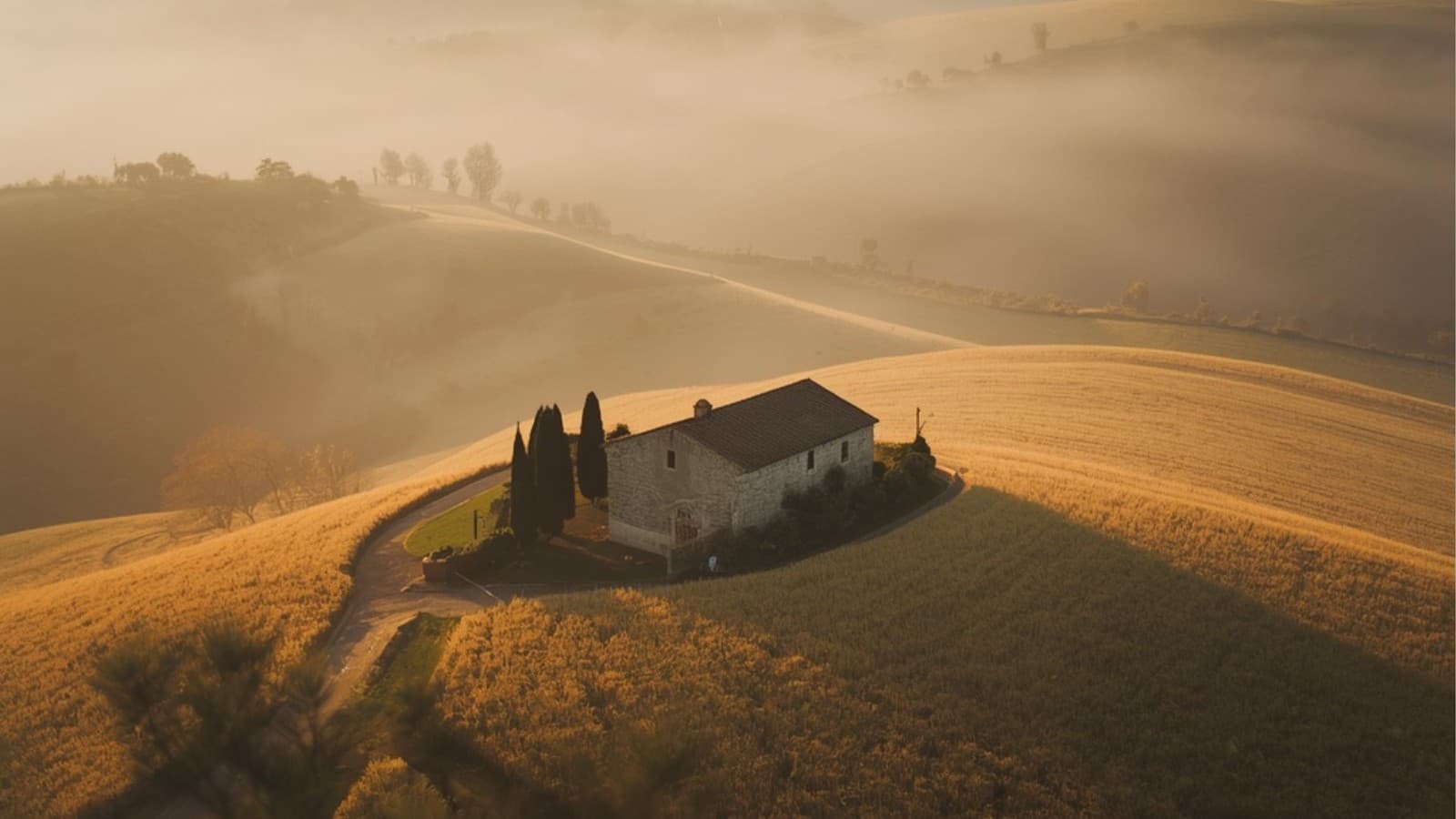
Discover the breathtaking beauty of Tuscan farmhouse mornings — golden wheat fields glowing at dawn, soft fog rolling through ancient valleys, and the timeless rustic charm of the Italian countryside. Your complete travel and visual guide to Tuscany's most magical hour.
Tuscan Farmhouse Morning Views: Golden Wheat Fields, Soft Fog & Rustic Beauty
There is a particular kind of stillness that belongs only to the Tuscan countryside at dawn. Before the heat of the day settles in, before the roads fill and the towns wake, the landscape does something extraordinary. Thick fog drifts low across rolling hills, wheat fields catch the first light and turn the color of warm honey, and the silhouette of a stone farmhouse emerges slowly from the mist like a painting coming into focus. If you have ever wanted to understand why Tuscany has captivated artists, poets, and travelers for centuries, the answer arrives in that hour between darkness and full morning.
This guide is for anyone who wants to experience — or simply understand — the quiet magic of a Tuscan farmhouse morning. Whether you are planning a trip, curating a travel aesthetic board, or searching for the soul of the Italian countryside, this is where it lives.
Why Tuscany Mornings Are Unlike Anywhere Else in the World
Tuscany occupies a rare place in the travel imagination. It is not just a destination — it is an atmosphere, a quality of light, a pace of living that feels deliberately slower and more intentional than the rest of the world. And nowhere is that feeling more concentrated than in the hours just after sunrise.
The region sits at an elevation that creates predictable morning fog banks, particularly in spring and late summer. These low clouds settle into the valleys between the famous cypress-lined hills, leaving hilltop farmhouses and villas rising above the white mist like islands. The visual effect is so consistent and so dramatically beautiful that landscape photographers have chased it for generations.
What makes it more than just a pretty scene is the way the light behaves. Tuscany's golden hour — the forty-five minutes after sunrise — bathes the wheat fields in a warm amber glow that contrasts perfectly with the cool blue-grey of the lingering fog. The textures become extraordinary: rough stone walls, terracotta roof tiles, silvery olive trees, and rows of dark green cypress all rendered in a light that softens edges and deepens color simultaneously.
The Geography That Creates the Magic
The Tuscan landscape is not accidental. Centuries of agricultural shaping — the terracing of hillsides, the planting of hedgerows and cypress windbreaks, the positioning of farmhouses on high ground for both view and ventilation — created a landscape that functions like a composed painting. Every element has a purpose, and together they produce mornings that look almost too beautiful to be real.
The Val d'Orcia, the Chianti region, and the hills around Montepulciano and Pienza are the most reliably photogenic areas. Fog is most common from late April through June and again in September and October. Wheat fields are at their most golden in late May and June, just before harvest.
The Golden Wheat Fields: What to Expect and When to Go
The wheat fields of Tuscany are one of the region's most iconic and underappreciated visual elements. Unlike the lavender fields of Provence or the tulip rows of the Netherlands, Tuscan wheat does not announce itself as a tourist attraction. It simply grows, turns golden, and waits for anyone paying close enough attention.
Peak Season for Golden Fields
Late May through mid-June is the window when the wheat reaches full height and maximum color. The fields transition from a bright spring green to a deep gold over the course of a few weeks, and the timing varies slightly depending on elevation and that year's weather. By late June, harvest begins and the fields return to bare earth.
If you are traveling specifically to photograph or experience the wheat fields in their full golden state, plan your visit for the last two weeks of May or the first ten days of June. Morning is non-negotiable — the afternoon light flattens the texture and the midday heat removes the atmospheric fog that gives the landscape its depth.
The Visual Composition of a Wheat Field Morning
Standing at the edge of a Tuscan wheat field at 6am is a full-sensory experience. The stalks move in slow waves with the earliest breeze of the day. The heads of grain catch light from a low angle, creating a warm shimmer across the entire field. In the middle distance, a line of cypress trees marks an old farm road, and behind them, the stone profile of a farmhouse sits perfectly still against a pale sky.
This is the composition that has appeared in Renaissance paintings, Italian cinema, and modern travel photography alike because it is genuinely that consistent. The landscape arranges itself.
Soft Fog in the Tuscan Valleys: A Photographer's and Traveler's Guide
The fog of Tuscany is not the grey, obscuring fog of a northern city. It is a theatrical element — selective, temporary, and transformative. It sits in the low valleys while leaving the hilltops clear, which means you can stand above it and watch it move.
Where to Watch the Fog
The single best place to experience and photograph Tuscan fog is the Val d'Orcia south of Siena. The road between Pienza and Montalcino offers elevated viewpoints that look directly down into fog-filled valleys with cypress-lined ridges breaking through above the white layer. The Agriturismo Terrapille near Pienza — famous for its lone cypress tree on a fog-filled ridge — is one of the most photographed spots in all of Italy and earns every bit of its reputation.
Other excellent positions include the hillside above San Quirico d'Orcia, the road approaching Monticchiello from the south, and the elevated terraces of any agriturismo in the Chianti Classico zone.
How Long the Fog Lasts
Tuscan morning fog is typically a one to two hour phenomenon. It begins forming before sunrise as temperatures drop overnight and begins burning off within forty-five minutes to an hour after the sun clears the horizon. The golden window — when fog is present and the light is warm and directional — is often as short as twenty to thirty minutes.
This is why every serious traveler and photographer sets an alarm. Arriving at a viewpoint at 7am when the fog began at 5:30 and cleared by 6:15 means missing the entire spectacle. The reward for an early alarm is a scene that most visitors to Tuscany never witness.
The Rustic Beauty of the Tuscan Farmhouse
No element of the Tuscan morning landscape carries more visual and emotional weight than the farmhouse itself. These structures — known locally as cascine or case coloniche — are built from the same pale limestone and sandstone that makes up the hills around them. They do not contrast with the landscape. They grow from it.
Architecture That Belongs to the Land
The typical Tuscan farmhouse is a two or three story rectangular structure with thick stone walls, small deep-set windows, and a clay tile roof weathered to a range of warm terracotta tones. Many are accompanied by a stone barn, a well, and an olive grove or small vineyard. The cypress trees planted as windbreaks centuries ago now stand forty or fifty feet tall alongside them.
What distinguishes the Tuscan farmhouse aesthetically is its complete absence of ornamentation. There are no decorative facades, no elaborate gardens in the formal sense. The beauty is entirely structural and material — the color of the stone, the weight of the roof tiles, the patina of centuries of weather on every surface.
Staying in a Farmhouse: The Agriturismo Experience
One of the most rewarding ways to experience Tuscan morning beauty firsthand is to stay in an agriturismo — a working farm that offers guest accommodation. Waking before sunrise in a stone farmhouse, walking outside into the cool morning air, and watching the fog lift from the valley below is an experience that no hotel in Florence or Siena can replicate.
Agriturismi range from rustic working farms with simple rooms to fully restored historic estates with swimming pools and gourmet dining. For the most authentic morning experience, choose one situated on a hillside with valley views, ideally in the Val d'Orcia or the hills south of Greve in Chianti.
How to Photograph Tuscan Farmhouse Mornings
Whether you shoot with a professional camera or a smartphone, the conditions of a Tuscan morning are genuinely forgiving for photography. The light is soft, the colors are warm, and the landscape has natural compositional structure built into it.
Camera Settings and Timing
Arrive at your chosen viewpoint at least thirty minutes before sunrise. The pre-dawn blue hour provides beautiful ambient light and gives you time to compose your shot before the fog begins moving with the wind. As the sun clears the horizon, switch to aperture priority and expose for the fog — letting the sky slightly overexpose will preserve the delicate tones in the mist.
For fog photography specifically, a slight underexposure of one third to two thirds of a stop often preserves more detail and atmosphere than the camera's metered reading suggests.
Composition Principles for This Landscape
The Tuscan landscape lends itself naturally to strong foreground, middle ground, and background separation — the foundation of landscape composition. Use a wheat field or olive grove as foreground texture, a farmhouse or cypress line as the middle element, and the fog-filled valley or pale morning sky as background.
Shooting from a slightly elevated position above the fog layer creates the most dramatic sense of depth and distance. Look for curved farm roads, dry stone walls, or rows of vines to create leading lines through the frame.
Slow Travel in Tuscany: Making the Most of the Morning
The Tuscan morning is not something to rush through on the way to a museum or a wine tasting. It deserves its own dedicated time in any itinerary, treated as a destination in itself rather than a backdrop for other activities.
A Simple Slow Morning Itinerary
Wake before sunrise and drive or walk to an elevated viewpoint with a clear sightline across a valley. Bring something warm to drink in a thermos and a light layer for the early chill. Watch the sky change from deep blue to soft pink and peach as the sun approaches the horizon. When the golden light arrives, take your photographs, but then put the camera down and simply look.
After the fog has lifted and the light has shifted to the harder brightness of mid-morning, find a local bar in the nearest village for an espresso and a cornetto. The contrast between the wild beauty of the landscape and the matter-of-fact normalcy of a bar stool and a small cup of coffee is very specifically Italian, and it is part of the experience.
Where to Stay for the Best Morning Access
For Val d'Orcia mornings, base yourself in or near Pienza, Montalcino, or San Quirico d'Orcia. All three are small hilltop towns with immediate access to the most photogenic countryside and enough agriturismo options to suit most budgets.
For Chianti mornings, the area around Gaiole in Chianti and Radda in Chianti offers slightly more forested and intimate landscapes with fewer visitors than the more famous zones further south.
What Makes the Tuscan Morning a Timeless Travel Experience
Tuscany has been a travel destination since the era of the Grand Tour, and it will remain one long after every travel trend has shifted. The reason is simple: the landscape does not depend on fashion or novelty. The morning fog does not need a filter. The wheat fields do not require a caption.
What the Tuscan farmhouse morning offers is something increasingly rare in contemporary travel — an experience that is genuinely, quietly beautiful, that asks nothing of you except attention, and that rewards that attention completely. You do not need a guidebook to tell you it is beautiful. You just need to be there before 7am, facing the right valley, in the right month.
That is, ultimately, the secret of Tuscany. Not the wine, not the art, not the food — though all of those are real and wonderful. It is the mornings. It has always been the mornings.
Final Tips Before You Go
Plan your visit for late May or early June for peak wheat field color and reliable morning fog. Base yourself in an agriturismo rather than a city hotel for direct access to the countryside at dawn. Set your alarm for at least an hour before sunrise and arrive at your viewpoint before the fog begins to move. Focus on the Val d'Orcia as your primary destination, with the hills around Pienza and Montalcino as your base. Bring a light layer and something warm to drink — mornings in the Tuscan hills are cool even in early summer. Spend at least two full mornings outdoors before adding any other activity to your day. Give the landscape the time it deserves.
Tuscany does not reward rushing. It rewards presence.
More in this Category
Prague After Midnight: Cobblestone Streets, Lantern Glow and Gothic Magic
Provence Lavender Season: Purple Fields, Perfect Light & Everything You Need to Know